Millet: The Versatile Ancient Grain That Feeds a Billion People
Millet is one of humanity's oldest crops, feeding over a billion people worldwide. Explore its types, nutrition, cooking methods, and drought-resistant qualities.
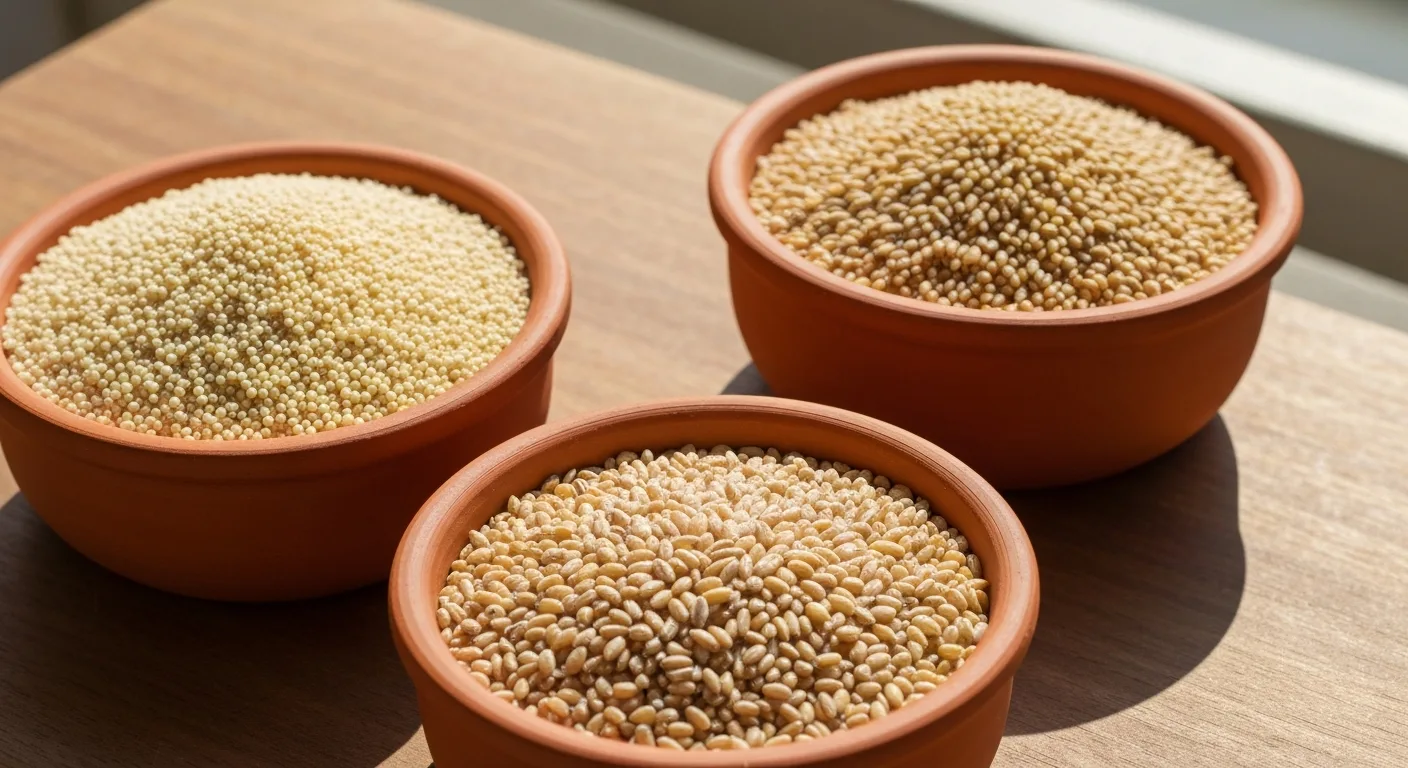
In the Western world, millet is often known primarily as birdseed. This is a major culinary misunderstanding. Millet is not a single grain but a family of crops that collectively feed over a billion people across Africa and Asia. It was domesticated before wheat, before rice, and before maize. It thrives in conditions that would kill most other food crops. And as climate change reshapes global agriculture, millet may prove to be one of the most strategically important grains on earth.
The United Nations underscored this point by declaring 2023 the International Year of Millets, a deliberate effort to raise awareness of these grains in wealthy nations and recognize their role in global food security.
What Is Millet?
“Millet” is a collective term for a group of small-seeded annual grasses cultivated as cereal crops. Unlike quinoa or amaranth (which are specific species), “millet” refers to several distinct species across different genera. They share common characteristics (small seeds, resilience to harsh growing conditions, and rapid maturation) but are not all closely related botanically.
The major millet species cultivated worldwide include:
Pearl Millet (Bajra)
Pennisetum glaucum - The most widely grown millet globally, pearl millet accounts for roughly half of all millet production worldwide. It is the dominant cereal crop in the semi-arid tropics of Africa and India, domesticated in the Sahel region of West Africa approximately 4,500 years ago. Pearl millet grains are larger than other millets (about the size of a peppercorn) and have a slightly nutty, mildly sweet flavor.
Pearl millet is exceptionally heat-tolerant and can produce grain in temperatures exceeding 40C (104F) and in soils too sandy and infertile for other cereals. In India, it is ground into flour for bajra roti (flatbread) and cooked as porridge. In West Africa, it is the foundation of thick porridges, couscous-like preparations, and fermented beverages.
Finger Millet (Ragi)
Eleusine coracana - Domesticated in the Ethiopian Highlands roughly 5,000 years ago, finger millet gets its name from the finger-like projections of its seed head. It is the nutritional standout among millets, containing the highest calcium content of any cereal grain: approximately 344 mg per 100 grams, rivaling dairy milk on a per-calorie basis.
Finger millet is a staple in parts of India (where it is called ragi), East Africa, and Nepal. In southern India, ragi flour is used to make ragi mudde (a dense, ball-shaped staple food), porridges, and fermented flatbreads. It has a distinctive earthy, slightly astringent flavor.
Foxtail Millet
Setaria italica - One of the oldest cultivated millets, foxtail millet was domesticated in northern China around 8,000 years ago, making it one of the earliest crops in East Asian agriculture. The name refers to the bushy, foxtail-like shape of its seed head. Foxtail millet has a mild, slightly sweet flavor and a light, fluffy texture when cooked. It remains widely cultivated in China, India, and Southeast Asia.
Proso Millet (Common Millet, White Millet)
Panicum miliaceum - The millet most commonly found in Western natural food stores, proso millet was domesticated in Central Asia and northern China approximately 7,000 years ago. It is the fastest-maturing cereal crop (some varieties reach harvest in as little as 60 days) and requires very little water. Its mild, neutral flavor makes it the most approachable millet for Western palates. Proso millet is what most Americans encounter when they see “millet” on a grocery shelf.
Other cultivated millets include kodo millet, barnyard millet, little millet, and browntop millet — each with regional importance, particularly in India.
A History Older Than Wheat
Millets are among the oldest cultivated crops on earth. Foxtail and proso millet cultivation in China predates rice cultivation by thousands of years. Archaeological evidence from the Cishan site in northern China dates millet cultivation to approximately 8,000 BCE, making these millets contemporary with the earliest wheat cultivation in the Fertile Crescent.
In Africa, pearl and finger millet were staple crops long before any other cereal took root on the continent. They sustained the development of complex societies across the Sahel, the Horn of Africa, and southern Africa.
In Europe, millet was important in the Bronze Age and remained significant through the medieval period before being displaced by wheat, barley, and rye. The word “millet” derives from the French millet, diminutive of mil, from the Latin milium.
Despite their antiquity and global importance, millets received far less research investment and agricultural development than wheat, rice, and maize during the Green Revolution of the mid-20th century. This neglect, driven by the focus on maximizing caloric output from a few high-yield crops, contributed to millet’s declining status even in regions where it had been cultivated for millennia.
Millet Nutrition
Millet’s nutritional profile varies by species but is consistently strong across the family. Here is what a one-cup serving (about 174 grams) of cooked proso millet provides:
- Calories: 207
- Protein: 6.1 grams
- Fat: 1.7 grams
- Carbohydrates: 41 grams
- Fiber: 2.3 grams
- Iron: 1.1 mg (6% DV)
- Magnesium: 77 mg (18% DV)
- Phosphorus: 174 mg (14% DV)
- Manganese: 0.3 mg (13% DV)
- Niacin (B3): 2.3 mg (14% DV)
- Thiamine (B1): 0.2 mg (13% DV)
- B6: 0.2 mg (9% DV)
Protein
Millet protein content ranges from 7-12% by dry weight depending on species, comparable to wheat and rice. The amino acid profile is reasonably balanced, though like all true cereal grains, millets are limited in lysine. Finger millet has a notably higher methionine content than most cereals, making it a useful complement to legumes.
Minerals and Vitamins
Millets are particularly rich in B vitamins (especially niacin, thiamine, and B6) and in magnesium, phosphorus, and potassium. Finger millet stands out dramatically for its calcium content — the highest of any cereal grain by a wide margin.
Iron content varies significantly by species. Pearl millet contains roughly 8 mg of iron per 100 grams of dry grain — high for a cereal. Proso millet is more modest. For a comprehensive nutritional comparison, see our ancient grains nutrition guide.
Anti-Nutrients and Goitrogenic Concerns
Millets contain compounds called goitrogens (specifically C-glycosyl flavones) that can interfere with iodine uptake by the thyroid gland. In populations that consume millet as a primary calorie source with inadequate iodine intake, this can contribute to goiter and hypothyroidism. This is primarily a concern in regions where millet dominates the diet and iodine intake is already marginal. For people eating millet as one grain among many in a varied diet with adequate iodine, goitrogenic effects are not considered a significant risk.
Processing methods like fermentation, malting, and cooking reduce goitrogen content substantially.
Millet Is Gluten-Free
All millets are naturally gluten-free and safe for people with celiac disease and gluten sensitivity. This makes the millet family one of the most valuable groups of gluten-free ancient grains available, alongside quinoa, amaranth, teff, and sorghum.
As with all gluten-free grains, cross-contamination during processing is possible. Look for certified gluten-free labeling when purchasing for strict celiac diets.
How to Cook Millet
Proso millet, the most commonly available variety in Western markets, cooks into fluffy, light grains when prepared with the right technique. The key variable is the water ratio, which determines whether you get fluffy individual grains or a creamy porridge.
Fluffy Millet (Pilaf-Style)
- Toast 1 cup millet in a dry saucepan over medium heat for 3-4 minutes, stirring frequently, until fragrant and lightly golden. This step is important — it develops flavor and helps the grains stay separate.
- Add 2 cups water or broth and a pinch of salt.
- Bring to a boil, reduce heat to low, cover, and simmer for 15 minutes.
- Remove from heat and let stand, covered, for 10 minutes.
- Fluff with a fork.
The result is similar in texture to couscous: light, fluffy, and mild.
Creamy Millet (Porridge-Style)
Use a 1:3 or 1:4 ratio of millet to liquid and stir frequently during cooking. The millet will break down into a creamy, polenta-like consistency. This works beautifully as a breakfast porridge with milk and sweetener, or as a savory side dish finished with butter and cheese.
Millet Flour
Millet flour is a versatile gluten-free flour with a mild, slightly sweet flavor. It works well in flatbreads (the traditional use across Africa and India), pancakes, muffins, and as part of gluten-free flour blends. It does not provide structure on its own, so it needs to be combined with binding agents for risen baked goods.
Culinary Uses Around the World
India: Bajra roti (pearl millet flatbread), ragi mudde (finger millet dumplings), ragi dosa (fermented finger millet crepes), khichdi (millet porridge with lentils and spices).
West Africa: Thick millet porridges served with stews, millet couscous, fermented millet beverages (dolo, tchapalo).
East Africa: Ugali (stiff millet porridge), fermented millet porridge, millet beer.
China: Millet congee (porridge), steamed millet, millet wine.
Russia/Eastern Europe: Millet porridge (pshennaya kasha), traditionally cooked with milk and butter.
Western countries: Grain bowls, salads, pilafs, polenta-style preparations, gluten-free baking.
Drought Resistance and Climate Change
Millet’s climate resilience makes it strategically important for global food security. Millets are among the most climate-resilient crops on earth:
Water efficiency. Pearl millet can produce grain with as little as 200-250 mm of seasonal rainfall, roughly half what wheat requires and a third of what rice needs. Some millet species can survive extended drought by entering dormancy and resuming growth when rain returns.
Heat tolerance. Millets thrive in temperatures that would devastate wheat, rice, and maize. Pearl millet grows productively at temperatures exceeding 40C.
Poor soil tolerance. Millets grow in sandy, acidic, low-fertility soils where most cereals fail.
Short season. Many millets mature in 60-90 days, allowing cultivation in short growing seasons and as catch crops between other plantings.
As climate change intensifies, bringing hotter temperatures, more erratic rainfall, and expanding arid zones, millets offer a proven, nutritious alternative to water-intensive staple crops. The International Crops Research Institute for the Semi-Arid Tropics (ICRISAT) and other organizations are actively working to improve millet varieties and expand their cultivation.
Buying and Storage
Proso millet is the most widely available variety in Western grocery and health food stores. Pearl millet flour (bajra) and finger millet flour (ragi) can be found at Indian grocery stores. Specialty grains retailers and online sources carry a broader selection.
Storage: Whole millet grain stores well for a year or more in an airtight container in a cool, dark place. Millet flour is more perishable — store in the refrigerator and use within a few months.
Millet’s Place Among Ancient Grains
On the ancient grains list, millet occupies a unique position as a family of crops rather than a single species. This diversity is both its strength and a source of confusion, since “millet” can mean very different things depending on species and context.
Compared to the pseudocereal stars quinoa and amaranth, millets cannot match the complete protein profile or the mineral density. But millets compensate with unmatched climate resilience, strong agricultural adaptability, deep cultural heritage across multiple continents, and a mild, approachable flavor that works in virtually any culinary context. Millet’s greatest asset may not be what it contains but where and how reliably it grows.
Last updated March 12, 2026